


Introduction
An air compressor is a mechanical device that converts power (usually from an electric motor or engine) into stored energy by compressing air and storing it in a tank. That compressed air can then be released to power a wide range of pneumatic tools — from tyre inflators and spray guns to impact wrenches and sand blasters. For beginners, understanding the variety of air compressors and their specifications is essential before buying.
On the product page of W‑Tools Direct, you’ll find a range of air compressors — from small-tank units to large 200 L or 300 L stationary compressors — each with different capacities, power ratings, and intended uses.
Types and Sizes of Air Compressors
On W-Tools Direct’s “Air Compressors” collection, several models are listed, each suitable for different needs and work environments.
Examples from the collection
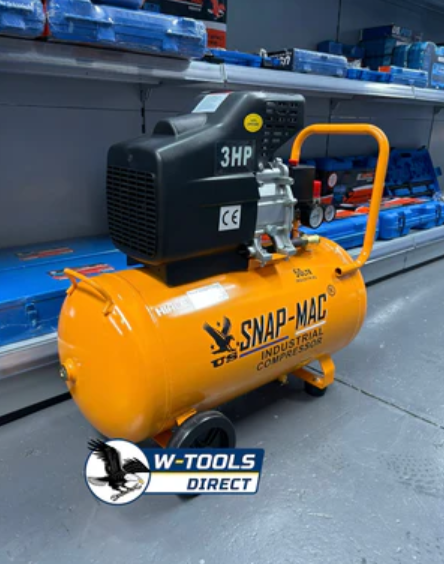
- 50 Litre Air Compressor, 3 HP — This lower-capacity compressor is often more compact and suitable for moderate tasks or smaller workshops.
- 100 Litre Air Compressor, 4 HP — Offering a larger tank and more power than the smaller units, this compressor can handle more demanding pneumatic tools or longer operation times.
- 200 Litre Air Compressor, 4 HP — With a significantly larger storage tank, this unit is useful for heavier-duty applications or continuous work where a larger reserve of compressed air is beneficial.
- 300 Litre Air Compressor, 4 HP — This large tank compressor is likely aimed at workshop or industrial-level tasks, where stable, sustained air output is required.
There are also standalone components — for instance, a “4 HP Air Compressor Motor 220V–240V Single Phase Electric Motor” — which can be used to build or repair compressors.
Key Specifications and What They Mean
When choosing an air compressor, there are several important specifications to understand. Based on the W-Tools Direct listings and general compressor knowledge, here are the key parameters:
- Tank Capacity (Litres): This defines how much compressed air the unit can store. Larger tanks (like 200 L or 300 L) give more reserve air, meaning tools can run longer before the motor recharges the tank. Choosing tank size depends on how long and how intensively you’ll use air tools.
- Motor Power (HP): Measured in horsepower (HP), this determines the compressor’s ability to fill the tank and provide sufficient pressure/airflow for tools. The W-Tools Direct catalog shows several units with 3 HP and 4 HP motors.
- Air Flow (CFM) & Flow Rate (L/min): For example, some units list “14 CFM / 398 L / MIN.” CFM (cubic feet per minute) or litres-per-minute indicates how much air the compressor can deliver. Higher CFM is important for running power-hungry pneumatic tools.
- Pressure Output (BAR / PSI): Pressure determines what pneumatic tools the compressor can power. On W-Tools Direct, many compressors are rated for 8 BAR / 115 PSI — a common pressure range for workshop tools.
- Power Source / Voltage: Most of the units listed use 220 V and are single-phase, suitable for standard electric supply (in regions where 220 V is standard).
Understanding these specs helps you match the compressor to your needs — whether for light tasks (like inflating tyres) or heavier work (like powering impact wrenches).
Matching Compressor Types to Use Cases
Your choice of air compressor should be shaped by how you plan to use it. Industry experts and compressor-manufacturing guidelines suggest the following:
Light / Domestic / Hobby Use
- Tasks like tyre inflation, airbrushing, or operating small pneumatic tools benefit from small to medium-tank compressors (e.g., 50 L to 100 L).
- These are easier to store, consume less power, and are usually cheaper.
Workshop / Garage / Moderate Use
- For tasks in a home workshop, small repair shop, or garage — like powering sanders, grinders, or small pneumatic wrenches — 100 L to 200 L compressors offer a good balance of capacity and portability.
- A 4 HP motor and around 14 CFM / ~400 L/min air flow with about 8 BAR pressure (as found in W-Tools Direct’s 100 L or 200 L units) is often sufficient.
Heavy Duty / Industrial / Continuous Use
- For continuous operation or multiple tools running over extended periods (e.g. in a workshop, small factory, or heavy-duty repair shop), 200 L and above (like 200 L or 300 L) compressors are ideal.
- Larger tanks ensure a reserve of compressed air, and more powerful motors help maintain steady airflow and pressure over time.
Advantages and Considerations — What Beginners Should Know
Advantages of Using Air Compressors
- Versatility: Air compressors can power a wide range of pneumatic tools — from tyre inflators and spray guns to heavy-duty sand blasters and impact wrenches. The W-Tools Direct catalog shows not just compressors but also accessories like sand-blasters, tyre inflators, hoses, jacks, etc.
- Efficiency for Tools: Many pneumatic tools perform better with compressed air rather than electric power, offering stronger torque or more consistent pressure.
- Scalability: Depending on your needs, you can start with a small compressor and upgrade to a larger one later.
Considerations Before Buying
- Tank Size vs. Actual Use: A large tank may be unnecessary if you only plan to do light tasks — and it could take up more space and cost more.
- Power Requirements: A compressor with a 3HP or 4HP motor (as listed on W-Tools Direct) will need adequate electrical supply. Single-phase 220 V works for domestic/workshop settings.
- Air Delivery (CFM / L/min): For pneumatic tools like impact wrenches or sand blasters — which consume high volumes of air — you need sufficient airflow. A low-flow compressor will struggle to keep up under load.
- Maintenance & Duty Cycle: Compressors need periodic maintenance — draining tank moisture, checking valves, ensuring correct pressure settings — especially for heavier use. In continuous operations, a compressor with a good duty cycle (able to run longer without overheating) is preferable.
How to Choose the Right Compressor for Your Needs
If you are a beginner and considering buying an air compressor (such as from W-Tools Direct), here’s a simple step-by-step approach:
- List out what you’ll use it for — tyre inflation, spray painting, power tools, sand blasting, etc.
- Estimate how often and how long you’ll use it — occasional home use vs. daily workshop tasks.
- Match usage with specifications:
- Occasional / light tasks → 50 L–100 L, 3–4 HP, lower CFM.
- Regular / workshop tasks → 100 L–200 L, 4 HP, 14 CFM / ~400 L/min, ~8 BAR.
- Heavy / industrial tasks → 200 L–300 L (or more), robust motor, high airflow and pressure.
- Check electrical requirements and space availability — ensure you have 220 V supply (as many listed compressors require) and enough space for tank and any extra accessories.
- Consider future needs and accessories — if you plan to add air-powered tools, sand blasters, or spray equipment, investing in a medium or large unit may save cost/time later.
What W-Tools Direct’s Air Compressor Range Tells Us
The “Air Compressors” collection on W-Tools Direct demonstrates a clear product range catered to different needs:
- Small-capacity compressors (like the 50 L, 3 HP model) for lighter tasks.
- Mid-range compressors (like 100 L, 4 HP) for workshop and moderate tool usage.
- Large-capacity compressors (like 200 L and 300 L, 4 HP) for heavy and continuous use.
- Basic components — such as standalone pump/motor heads — enabling repair or custom build of compressors.
This variety confirms that when choosing an air compressor, there’s no “one-size-fits-all” — the best choice depends on what you intend to do, how often, and under what conditions.
Basic Maintenance and Best Practices
Though the W-Tools Direct product page doesn’t detail maintenance, combining general compressor guidance with buying info can help beginners ensure their compressor lasts and performs well:
- Drain moisture from the tank regularly. Compressed air often contains moisture — if left unchecked, it can cause rust or damage inside the tank.
- Check hoses and fittings before each use. Ensure there are no leaks, cracks, or wear — leaking air reduces performance and may cause safety issues.
- Match tool requirements with compressor capacity. High-demand tools need sufficient airflow (CFM) and pressure; otherwise, performance suffers or compressor may overwork.
- Allow cooldown periods or monitor duty cycles. For heavy or continuous work, a compressor may need rest or cooling to avoid overheating.
- Use the correct voltage and ensure stable power supply. As many compressors (like those on W-Tools Direct) use 220 V single-phase motors, an inadequate supply can damage them or cause poor performance.
Conclusion
Air compressors are powerful, versatile tools — but for beginners, choosing the right one requires understanding the core specs: tank capacity, motor power, airflow (CFM/L-min), pressure (BAR/PSI), and intended usage. By using the range shown on W-Tools Direct as a reference, you can clearly see how compressors scale from small-tank units for light work to large 200 L–300 L compressors designed for heavy-duty use.
For your first compressor, pick based on the kind of work you expect to do — whether occasional tasks like tyre inflation or heavy workshop jobs. Ensuring you match the compressor’s specs to your needs will save time, money, and frustration. With proper maintenance and understanding of airflow/pressure requirements, an air compressor can become a valuable part of your workshop or home toolbox.