


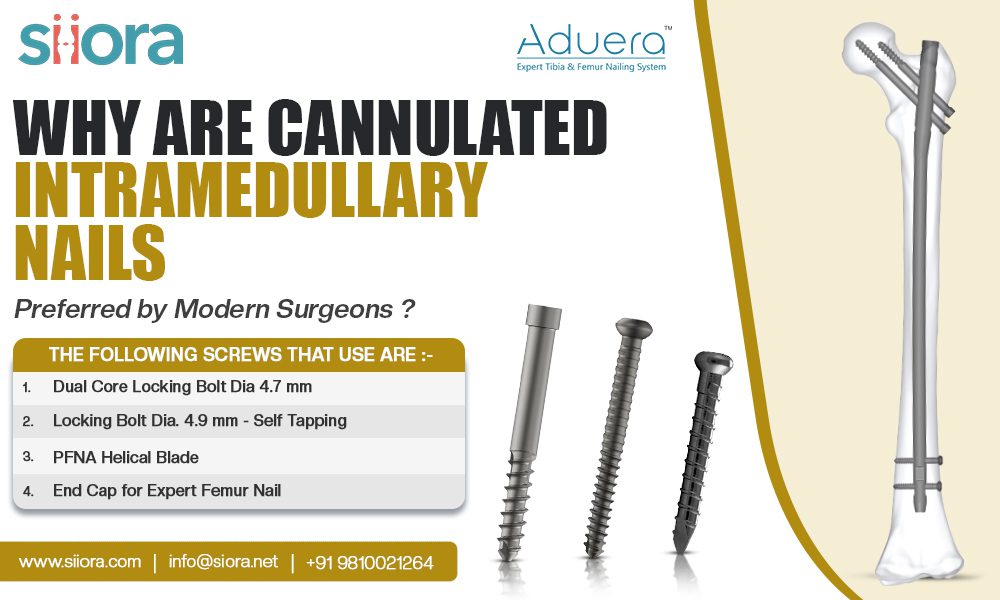
Over the past decade, fracture management has steadily moved toward techniques that are less invasive and more precise. Surgeons today are not only concerned about stabilizing the bone but also about preserving biology and reducing surgical trauma. Cannulated intramedullary nails femur, tibia, and humerus fit well into this approach. They offer stability while allowing better control during the procedure, which is one reason many modern surgeons now prefer them.
What Makes a Nail Cannulated?
A cannulated intramedullary nail has a hollow center. This design allows the nail to be inserted over a guidewire. While this may sound like a small technical detail, in practice it makes a significant difference. The guidewire helps the surgeon maintain alignment throughout the procedure. It reduces guesswork and supports more accurate placement, especially in complex fractures.
In contrast, solid nails require more direct manipulation and can be less forgiving when alignment is slightly off.
Improved Surgical Accuracy
One of the biggest advantages of cannulated nails is precision. Because the implant follows a guidewire, surgeons can confirm positioning before fully advancing the nail. This lowers the chances of malalignment. In long bone fractures such as the femur, tibia, or humerus, even small deviations can affect healing and function.
The guidewire system also allows better control in patients with narrow canals or challenging anatomy. For younger surgeons in training as well as experienced specialists, this added accuracy provides confidence during the procedure.
Minimally Invasive Benefits
Modern orthopedic practice strongly favors minimally invasive techniques. Cannulated intramedullary nails support this principle. Since the guidewire helps with targeting, there is often less need for repeated adjustments. This can shorten operative time and reduce soft tissue disruption.
Smaller incisions and limited periosteal stripping help preserve the blood supply around the fracture site. Preserving this biological environment plays an important role in faster and more reliable bone healing.
Better Outcomes in Complex Cases
In comminuted or segmental fractures, maintaining proper alignment can be difficult. Cannulated systems make it easier to achieve stable fixation while keeping the fracture biology intact. Surgeons can use the guidewire to check the length and rotation before locking the nail in place.
This controlled approach reduces the risk of secondary procedures caused by malunion or hardware complications. Over time, these small advantages contribute to improved overall patient outcomes.
Ease of Learning and Standardization
Another practical reason for their popularity is standardization. Many modern implant systems are built around cannulated designs. Surgical steps become more structured and reproducible. This consistency is helpful in busy trauma centers where efficiency matters.
For teaching hospitals, cannulated systems also make it easier to train residents. The guidewire-based method provides a clear sequence that can be followed and repeated safely.
Final Thoughts
Cannulated intramedullary nails have become a preferred option, not because they are new, but because they make surgical fixation more controlled and predictable. By combining precision, a minimally invasive technique, and reliable stability, they align well with the goals of modern orthopedic care.While no trauma implant is perfect for every case, cannulated nails offer practical advantages that support better alignment, smoother procedures, and dependable healing. For many surgeons today, that balance is reason enough to choose them.


